How to Scale Your Startup Team: The TPM's Hiring Playbook
Moeed Qadeer
Technical Project Manager
You started with 3 people. It worked. Now you have 8. The cracks are starting to show. Code reviews are inconsistent. Tasks slip through. Onboarding took 3 weeks instead of 3 days. And nobody can agree on how to run a sprint.
This is where most startups stumble. Attracting and retaining skilled individuals becomes increasingly challenging as your startup expands. It's not just about recruitment; it's about building an engineering organization that scales.
Part 1: Understanding the Startup Scaling Crisis
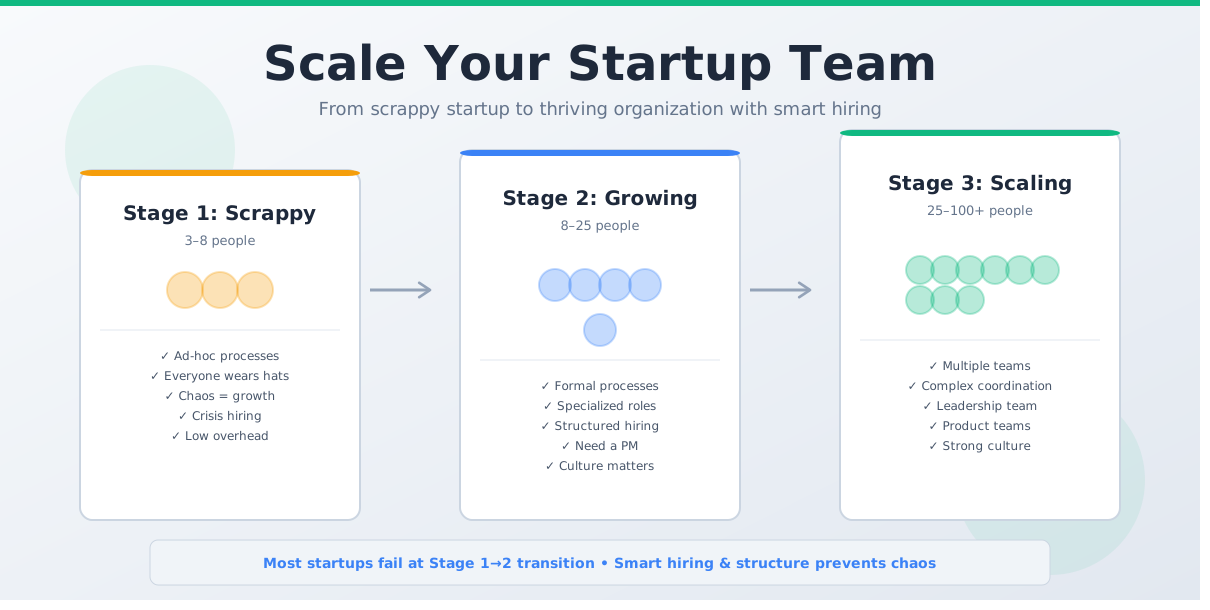
- Stage 1: Scrappy Phase (3–8 people) - Everyone wears multiple hats. Hiring is crisis-driven.
- Stage 2: Growing Phase (8–25 people) - Processes formalize (sprints, standups, documentation). Roles specialize. Hiring becomes strategic.
- Stage 3: Scaling Phase (25–100+ people) - Multiple teams. Coordination complexity explodes. Formal recruitment pipelines needed.
The Crisis Point: Most startups fail at the transition from Stage 1 → Stage 2. They hire too fast without structure, creating chaos.
Part 2: Pre-Hiring: Get Your House in Order
1. Defined Roles & Responsibilities
What does each position actually do? Without clarity, you hire generalists. Define explicitly what they are responsible for, required skills, and what they are NOT responsible for.
2. Compensation & Benefits Framework
Nothing derails a startup faster than paying based on bank balance. Build a compensation band (Base Salary + Equity) before hiring.
3. Hiring Process & Timeline
Design a structured 3-4 week hiring pipeline: Sourcing → Screening → Interviews → Offer & Onboarding. Target time-to-hire is 21 days.
Part 3: Onboarding: The First 30 Days
This is where startups fail. Great hire, terrible onboarding, mediocre output.
- Days 1–5 (Week 1): Orientation - Laptop setup, vision alignment, product walkthrough, first small bug fix.
- Days 6–14 (Week 2): Ramp-Up - Complete first feature, pairing sessions, review docs, observe meetings.
- Days 15–30 (Weeks 3–4): Independence - Own a small feature end-to-end, lead a code review, participate in planning.
Part 4: Hiring Challenges & How to Overcome Them
Challenge #1: Hiring Speed vs. Quality
Solution: The "Interim Contractor + Full-Time Hire" Model. Hire a 4-week contractor to fill the gap while running a full hiring process in parallel.
Challenge #2: Skill Misalignment
Solution: Paid, structured technical assessments. Give them a 2-3 hour real-world code problem before the final interview.
Challenge #3: Nearshore/Offshore Hiring Friction
Solution: The Hybrid Model. Structured async communication, document-first approach, and overlapping timezone syncs led by a senior resource.
Conclusion
Here's the truth: Your product doesn't scale. Your team scales. A single bad hire in the first 10 people can set you back 6 months.
Get hiring right—clear roles, structured process, thoughtful onboarding, growth paths—and you'll scale from 5 to 50 people without losing culture or velocity.
Need a Technical Expert for Your Next Project?
Whether you're launching a new startup, building a complex SaaS platform, or need to optimize your Agile workflows, I can help you deliver your product faster and smarter.